Koh Samui Temples: Which Ones Are Actually Worth Your Time
Koh Samui temples ranked by two locals. The prettiest, the famous one, the mummified monk, the red one, and the sculpture park that isn't a temple at all.
May · September 8, 2026

Nobody flies to Koh Samui for the temples, and that's exactly why the temples here are good. No queue that eats your morning, no scaffolding, no guide with a flag. The Koh Samui temples worth seeing fit into two short outings, they're free apart from one impostor we'll get to, and the best of them involves feeding fish while a goddess with eighteen arms watches you do it.
We live in Chaweng Noi and these are the stops we actually send guests to, ranked honestly, including the one that isn't a temple at all no matter what the sign implies.
The rules, before anything else
Every working temple on this island runs on the same three rules. Shoulders and knees covered. Shoes off before you go in or up. Entry free, donation boxes optional. That's it. Keep a sarong in the car and you will never be the person arguing with a monk in a vest and short shorts, a scene we have watched more than once and which the monk wins every time.
One more thing, because it needs saying: these are active religious sites with real congregations, not photo sets. Keep your voice down, don't climb on anything, and the whole island will be lovely to you.
Wat Plai Laem: the prettiest one
If you only see one temple on Samui, make it Wat Plai Laem. It's the modern Chinese-Thai complex on the northeast corner, built out over a lake, with a white eighteen-armed statue of Guanyin rising straight out of the water and a fat, grinning Budai laughing at her from across the pond. The main pavilion sits on a giant sculpted lotus. It's free, parking is free, and the only money you'll spend is 10 baht on a bag of fish food from the vending machine, which is the best 10 baht on the island.
Hours run roughly 6am to 6pm. Go early, give it an hour, and you'll have the bridges mostly to yourself before the tour vans arrive.
Big Buddha (Wat Phra Yai): the famous one
The 12-metre gold statue you saw from the plane window. Big Buddha has been sitting on his little island off the northeast tip since 1972, joined to Samui by a paved causeway, five minutes from the airport. He is the island's most famous landmark and, unusually for famous landmarks, he's actually worth the stop.
The catch is the staircase. It's tiled, you climb it barefoot, and by midday the sun has turned it into a griddle. Go at opening, around 7am, when the tiles are cool and the tour groups haven't built up, or go late for the sunset light. He's 1.2 kilometres from Wat Plai Laem, so the two are one outing, not two. Anyone who tells you they're separate trips is padding an itinerary.
Wat Khunaram: the strange one
Down on the south coast, on Route 4169, sits the temple most people have to be talked into and nobody regrets. Inside a glass case at Wat Khunaram is Luang Pho Daeng, a monk who died while meditating in 1973 and directed that his body be displayed as a reminder that nothing lasts. Half a century on he is still upright in the meditation pose, remarkably well preserved, wearing sunglasses because the eyes were the one part that didn't hold.
It sounds macabre. It isn't. It's quiet, oddly moving, and one of the most genuinely memorable non-touristy stops on the island. It's a short visit, so fold it into a south-coast run with Hin Ta and Hin Yai and the Na Muang waterfalls, which are all on the same loop.
Wat Sila Ngu: the red one
On the south coast above Hua Thanon Beach, a few minutes past Lamai, is Wat Sila Ngu, officially Wat Ratchathammaram, and it looks like no other temple on this island. The main building is carved terracotta, deep rust-red from roof to base, covered in detail that rewards standing still and actually looking. On the seafront courtyard there's a golden chedi with the sea behind it, and stairs run down toward the water.
It gets a fraction of the traffic the northeast pair gets, which is half the appeal. Listed hours are 8am to 5pm. Pair it with a wander through Hua Thanon's fishing village next door and you've got the least touristy temple stop on the island.
The Secret Buddha Garden: the one that isn't a temple
Here's the correction nobody at the ticket gate will make for you. The Secret Buddha Garden, also sold as the Tarnim Magic Garden, is not a temple. It's a private sculpture park up Pom Mountain, started in 1976 by Nim Thongsuk, a retired durian farmer who was 77 when he began hauling statues up a hill. It charges entry, 80 to 100 baht depending on who you ask, and the last 4 kilometres of road are a rough uphill track that has ended more scooter holidays than the bars have.
It's worth seeing. It's just a different kind of trip: paid, remote, and reached by a road that wants a real car. Don't put it on the same morning as the actual temples and don't expect gold and incense at the top. Expect moss, stone angels, and one man's 14-year argument with a mountain.
How to do the Koh Samui temples in two mornings
Two outings. That's the entire temple itinerary for this island.
Morning one: Wat Plai Laem, then Big Buddha, done by 10am, back in the pool before the heat gets rude. Morning two, later in the week: the south-coast loop of Wat Khunaram, Wat Sila Ngu, the rocks, the waterfalls, lunch somewhere in Hua Thanon. The Secret Buddha Garden is its own half day, only if the road doesn't scare you.
That's the honest maths. Temples here are mornings, not marathons, which is precisely how a Samui holiday should treat its sightseeing.
Quick answers
Does Koh Samui have temples?
Yes, working Buddhist temples all over the island. The big three for visitors are Wat Plai Laem and Big Buddha in the northeast and Wat Khunaram in the south, with the red Wat Sila Ngu near Lamai as the quiet fourth.
Which Koh Samui temple is best?
Wat Plai Laem for beauty, Big Buddha for fame, Wat Khunaram for a story you'll tell at dinner for years. They're free, so you don't have to choose.
Are the temples in Koh Samui free?
The working temples are, with donation boxes if you want to give. The one paid entry in this list is the Secret Buddha Garden, which is a private sculpture park, not a temple, at 80 to 100 baht.
What should I wear to a temple in Koh Samui?
Shoulders and knees covered, shoes off inside and on the stairs. A sarong over beachwear solves it. They do turn people away, so don't test it.
What else is Koh Samui famous for?
Beaches, food, and a very specific kind of doing nothing well. We've covered what the island is actually known for on the food side, and the temples above are the culture half of the answer.
The Villa
Come stay above the bay.
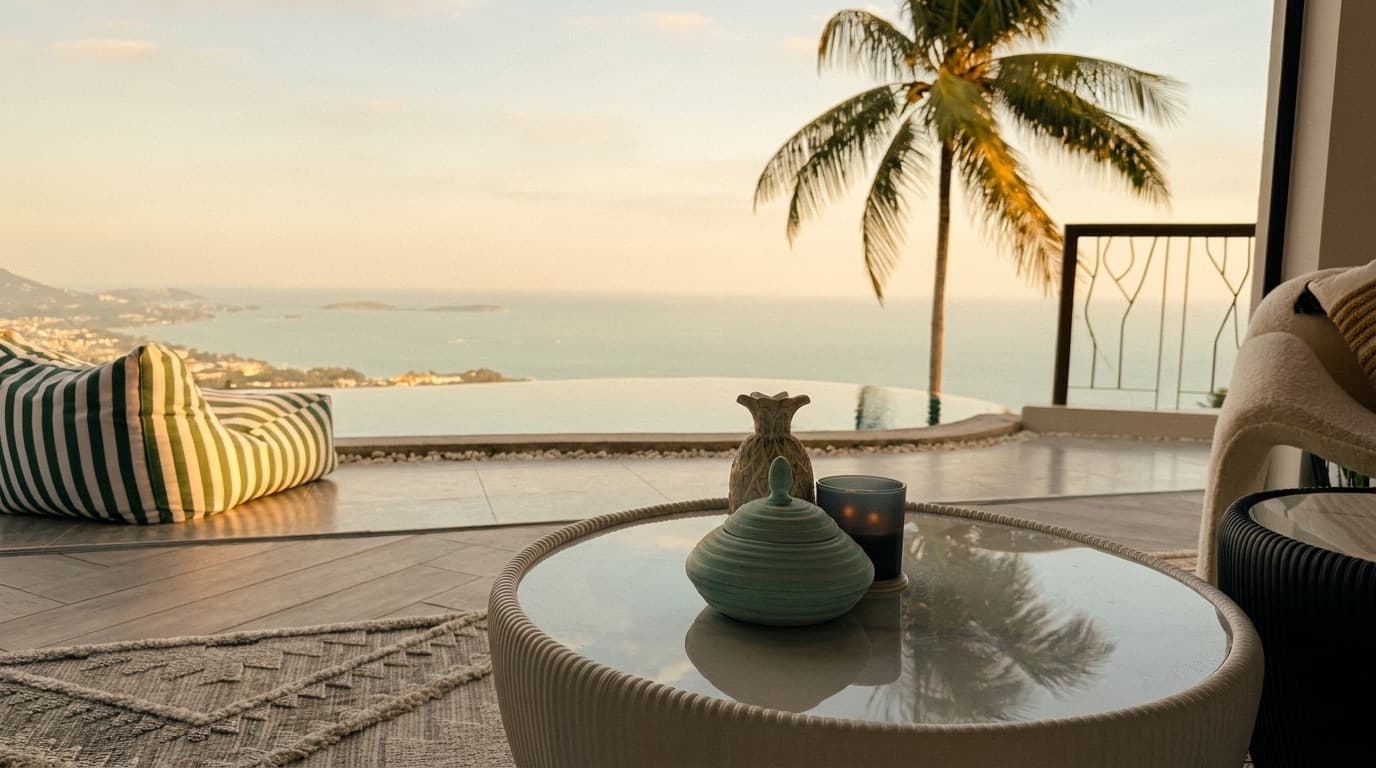
Sabai Sabai is a three-bedroom villa on the cliffs above Chaweng Noi, with an infinity pool and the whole Gulf of Thailand below.
See the villa →Written by
May
Living in the sunshine