Wat Khunaram and the Mummified Monk of Koh Samui
The Wat Khunaram mummified monk is Koh Samui's strangest sight. Who Luang Pho Daeng was, why he wears sunglasses, and how to visit respectfully. By two locals.
May · September 9, 2026

Let's get the awkward part out of the way. Yes, the Wat Khunaram mummified monk is a real man, in a real glass case, in a real working temple on Koh Samui's south coast. Yes, he's wearing sunglasses. And no, visiting him is nothing like you're imagining. People arrive braced for a horror show and leave quiet, a little moved, and full of questions. This is the story, all of it sourced, because this is one topic where getting the details wrong would be genuinely rude.
We live over the hill in Chaweng Noi and this is the stop we have to talk guests into. Nobody regrets it. It's a short visit, it costs nothing, and it's the sight people are still talking about on the flight home.
Who Luang Pho Daeng actually was
The man in the case is Luang Pho Daeng, known formally by his monastic title Phra Khru Samathakittikhun. He was born on Koh Samui in 1894, ordained as a monk at around twenty, then did something monks are quietly allowed to do: he left. He disrobed, married a local woman, and raised six children.
At fifty he went back. He returned to the temple, gave himself to meditation and the study of Buddhist texts, and became one of the most revered monks on the island. He died in 1973, at 79.
That biography matters, because it's the answer to the question everyone whispers in the hall: why him? Not a lifelong ascetic. A husband and father who went back to the robes at an age when most people are winding down, and finished the job properly.
The last week, and the instruction he left
In his final week, Luang Pho Daeng stopped eating, stopped drinking, and stopped speaking. He sat in meditation, and he died in it, still upright in the lotus position.
Before that, he left his followers one instruction with two branches. If his body decayed, cremate it, the normal way. If it didn't decay, put it on display in a glass casket in the temple, as a reminder that nothing about a human life is permanent.
It didn't decay. More than half a century later he is still sitting upright in the case, in his robes, preserved naturally without chemicals. That's the entire reason the temple is famous, and it's also the point most visitors miss: the display isn't a stunt. It's the man's own teaching, delivered exactly the way he asked.
About the sunglasses
The question the whole internet asks, so here's the honest answer. His eyes were the one part of him that didn't hold. The sockets dried out, and dried eye sockets are confronting in a way a peaceful seated body is not. So the temple gave him sunglasses.
The effect, seeing him for the first time, is strange. A monk in shades sounds like a joke, and then you're standing there and it isn't one. It reads as care. The people of this temple have been looking after him for fifty-odd years, and the glasses are part of that.
Visiting the Wat Khunaram mummified monk: what it's actually like
Wat Khunaram sits on Route 4169, the ring road, on the south coast between Na Muang and Hua Thanon. It's an ordinary, living temple: locals come to make merit, and there's a set of Buddha statues, one for each day of the week, where Thai visitors pay respect at the one for the day they were born.
Luang Pho Daeng sits upright in his glass casket, surrounded by flowers, candles, incense and fruit offerings. Photography is allowed if you're respectful about it, though we'd gently suggest standing still for a minute first. The looking is the point. Come early in the morning or toward evening if you want him mostly to yourself.
Entry is free. There's a donation box, and this is the one stop on the island where we'd say use it. Hours are daylight, roughly 8am to 5pm. Dress like it's a temple, because it is one: knees and shoulders covered, shoes off where everyone else's are. A sarong in the day bag solves it.
Fold it into a south-coast morning
The visit itself is short, so nobody drives out for it alone. It slots into the classic south-coast loop from our temples rundown: the Na Muang waterfalls are on the same loop, Hin Ta and Hin Yai sit on the coast road back toward Lamai, and Hua Thanon's fishing village is next door for lunch. From Chaweng Noi or Lamai it's an easy morning: waterfalls, the monk, lunch in Hua Thanon, home for the pool by early afternoon.
Why this isn't ghoulish
Fair question, and we asked it ourselves before the first visit. Here's the distinction. A sideshow displays a body for money against its owner's wishes. Wat Khunaram displays a body for free, at its owner's explicit request, to make his one final argument: that everything ends, including you, so live accordingly. Buddhists have used meditation on impermanence this way for centuries. He just made himself the lesson.
You can decide how you feel about that in the hall. Most people, watching Thai families bring their kids through without a flicker of fear, land somewhere between respect and awe. It is the least haunted place on the island.
Quick answers
Is the mummified monk in Koh Samui real?
Yes. Luang Pho Daeng is a real monk who died in 1973, and his body is genuinely his, preserved naturally without chemicals. He asked for the display himself: cremation if his body decayed, the glass casket if it didn't.
Why does the mummified monk wear sunglasses?
His eyes didn't survive the drying process, and the empty sockets were a harder sight than the temple wanted visitors to face. The sunglasses were added out of respect, not style.
How much is the entrance fee at Wat Khunaram?
Free. There's a donation box for the temple's upkeep, and it deserves your spare notes more than most places on the island.
What are Wat Khunaram's opening hours?
Daylight hours, roughly 8am to 5pm. Early morning and late afternoon are the quiet ends of the day.
Where is Wat Khunaram?
On Route 4169 on the south coast, between Na Muang and Hua Thanon, about six kilometres from Lamai. It makes an easy stop on any south-coast loop.
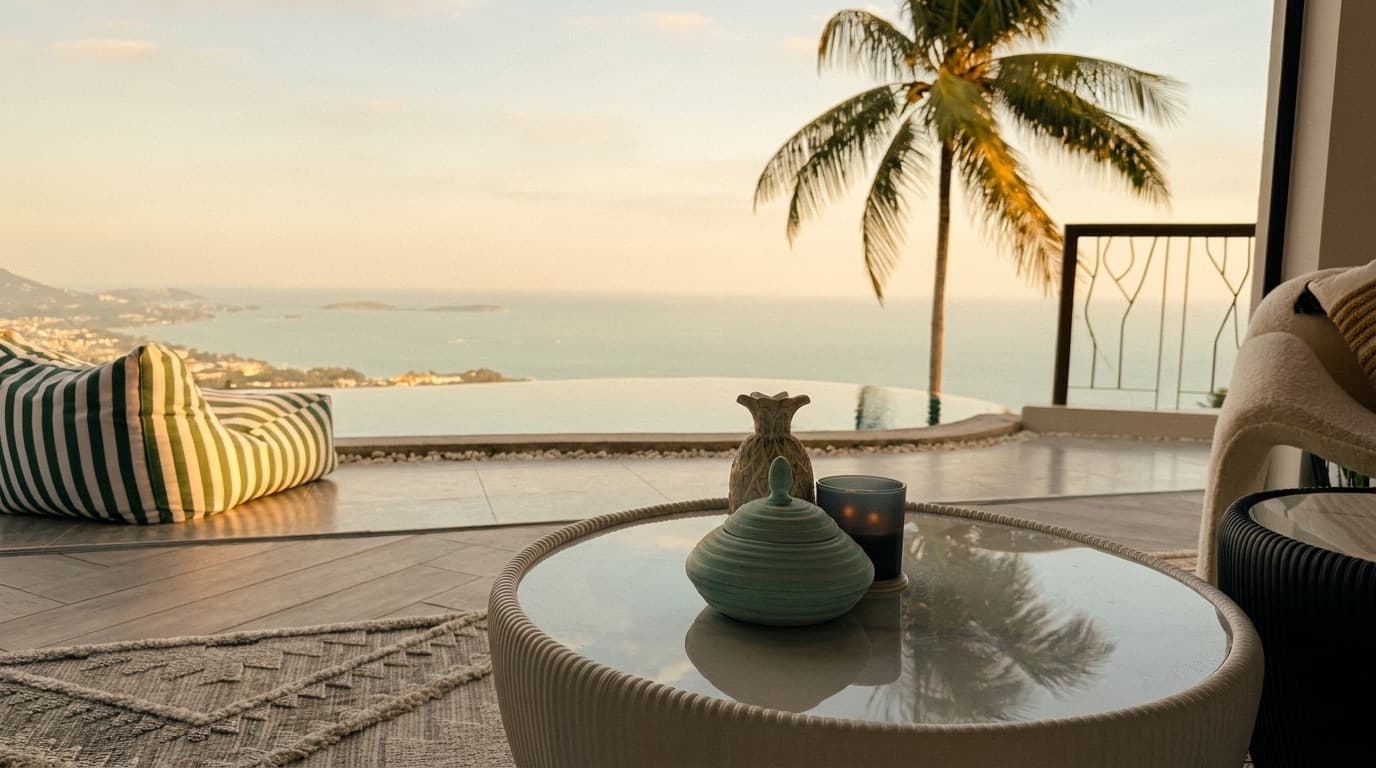
The Villa
Come stay above the bay.
Sabai Sabai is a three-bedroom villa on the cliffs above Chaweng Noi, with an infinity pool and the whole Gulf of Thailand below.
See the villa →Written by
May
Living in the sunshine