Big Buddha Koh Samui: The Honest Guide to the Island's Most Famous Temple
Big Buddha Koh Samui, from two people who live here. What to wear, when to go, whether it's free, and the two temples worth pairing with it.
May · July 22, 2026
You will meet Big Buddha in Koh Samui before you land. He sits on Koh Fan, a little island off the northeast tip, right under the flight path, so the plane tips its wing and there he is, twelve metres of gold catching the sun while you're still fumbling for your seatbelt. Then everyone forgets him for a week and visits on the last afternoon in a sweaty rush. Do the opposite. Go first, go early, and go with a shirt that covers your shoulders.
We live one bay down the coast in Chaweng Noi, so this is the trip we send guests on when they want one genuinely worthwhile morning that isn't a beach. Here's what actually matters.
What Big Buddha actually is
Big Buddha is a 12-metre, gold-painted statue built in 1972, and yes, he is exactly as big and shiny as the seventies intended. The formal name is Wat Phra Yai, "wat" being the Thai word for temple, so the whole site is more than the statue: outbuildings, a wheel of life, dragon detailing curling up behind his head, quiet corners, and a run of gift shops and ice cream at the gate. Sometimes a thing is famous because it's good. This is one of those times.
He sits on Koh Fan, technically its own little island, joined to Samui by a causeway that's now paved, so you just walk or drive straight across. You'll find him up in the northeast, between Bang Rak and Choeng Mon, a short hop up the coast from Chaweng. If you've just flown in, he's five minutes from the airport, which makes him a very good first stop or last stop of a trip.
When to go, and the hot-stairs problem
There's a steep flight of stairs up to the statue, and they are tiled, and by midday those tiles are hot enough to make you regret every decision that led you there barefoot. You take your shoes off before you climb, that's the rule at any temple, so the sun turns the staircase into a griddle. Go early morning when it's cool and calm, or late for sunset when the gold goes properly warm. Skip the middle of the day. If you're stubborn and go at noon anyway, bring a pair of socks. Grippy ones. We're not joking, and neither are the tourists hopping up those stairs like the floor is lava, because it is.
Early has a second payoff: fewer people. The tour groups build through the morning, so first thing it's mostly you, a few monks, and a very large man made of gold.
What to wear (they will turn you away)
This is a working religious site, not a photo backdrop, so shoulders and knees stay covered. Monks at Big Buddha genuinely turn away people in vests and short shorts, and there's an enormous sign saying exactly this that people somehow still miss. A sarong or a light cover-up in your bag solves it in two seconds. Bring one. Being sent back down the hot stairs to change is a special kind of holiday low.
The two temples worth pairing with it
Big Buddha is the headline, but you're already up in the northeast, so make it a temple morning.
Wat Plai Laem is a few minutes away and, honestly, the prettier stop. It's a modern temple that leans into both Thai and Chinese tradition, built on a small island in a shallow lake. The showpiece is a white statue of Guanyin, the goddess of mercy, with eighteen arms fanned out, and across the water a fat, grinning laughing Buddha who looks like he's heard a very good joke. You can feed the fish in the lake. It's free, it's calm, and it photographs beautifully without any of the stair-climbing.
Wat Khunaram is the strange one, down on the south side of the island, the same run as the Grandfather and Grandmother rocks, if you're doing a proper loop. Inside a glass case sits Luang Pho Daeng, a monk who died in 1973 and asked to be left on display as a reminder that nothing lasts. He is remarkably well preserved, still upright in the meditation pose, and he is wearing sunglasses, because the eyes were the one part that didn't hold. It sounds macabre and it isn't. It's quiet and oddly moving, and it belongs on any list of the island's genuinely odd corners.
All three are free. A small donation is always welcome, and at Big Buddha you can even pay a token amount to have a brick inscribed with your name for the ongoing construction, which is a better souvenir than a keyring.
Is it worth it?
Yes, and it takes far less time than people fear. Nobody needs a full day here. Half an hour to an hour at Big Buddha, the same at Wat Plai Laem, and you've had a real slice of the island by breakfast. Do it on your first morning while you're still jet-lagged and awake at six anyway. Then come back to the quiet side, get in the pool, and let the rest of the day do nothing. That's the whole point of basing yourself somewhere calm: the sightseeing is a morning, not the marathon.
Quick answers
Is Big Buddha Koh Samui free?
Yes. Entry is free. Donations are welcome, and you can pay a small amount to sponsor an inscribed brick, but nobody charges you at the gate.
Can you wear shorts to Big Buddha Koh Samui?
Long shorts that cover the knee are fine; short shorts and bare shoulders are not. It's an active temple, so shoulders and knees covered, and shoes off before the stairs. Carry a sarong and you'll never get caught out.
What are the opening hours?
Big Buddha opens early, around 7am, and stays open into the evening. Go near opening for cool stairs and no crowds, or at sunset for the light. Avoid midday.
Where is Big Buddha on Koh Samui?
On Koh Fan, a tiny island joined by causeway to Samui's northeast tip, between Bang Rak and Choeng Mon, about five minutes from the airport and a short drive up the coast from Chaweng.
The Villa
Come stay above the bay.
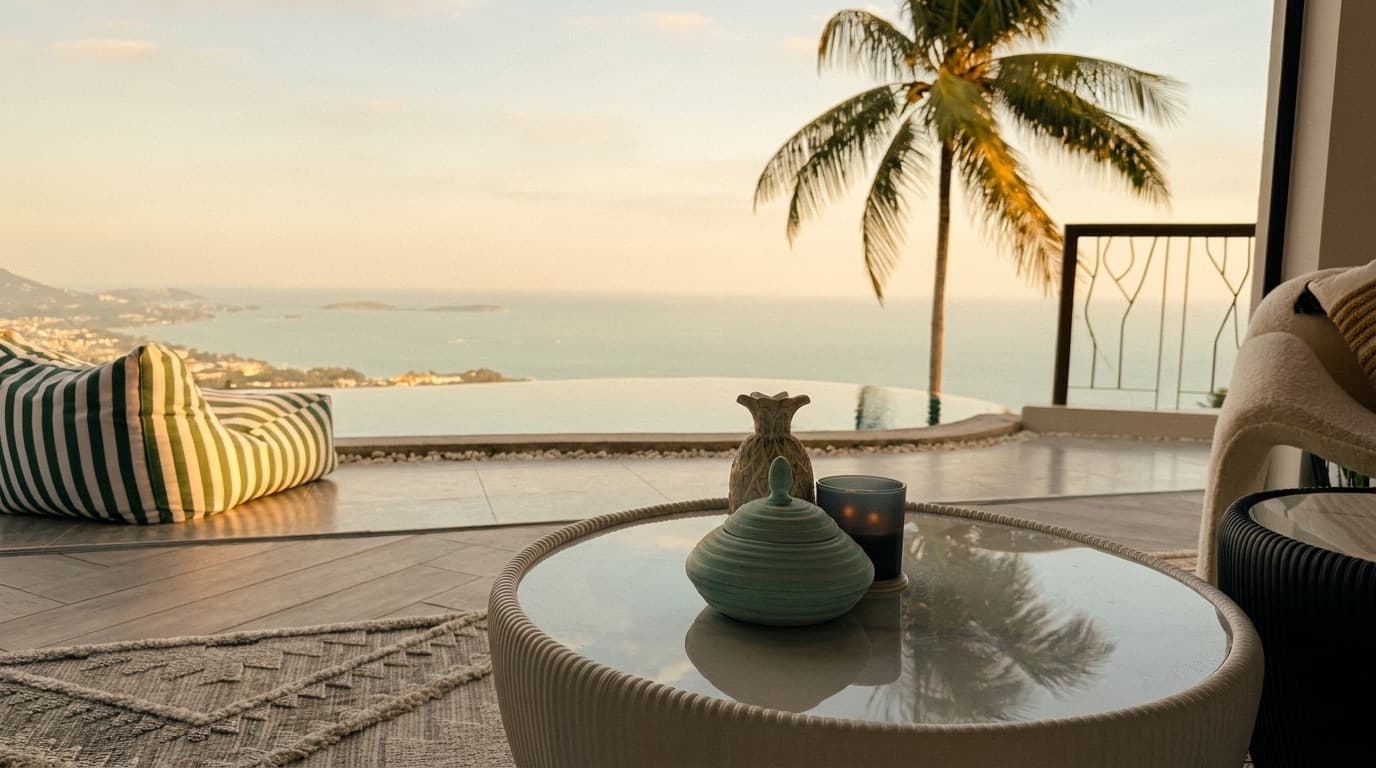
Sabai Sabai is a three-bedroom villa on the cliffs above Chaweng Noi, with an infinity pool and the whole Gulf of Thailand below.
See the villa →Written by
May
Living in the sunshine