Wat Plai Laem, Koh Samui: The Honest Guide to the Prettier Temple
Wat Plai Laem, Koh Samui, from two people who live one bay south. Hours, the actual dress code, what the eighteen arms mean, and why it beats Big Buddha for atmosphere.
May · August 15, 2026
Everyone comes to the northeast corner of the island for Big Buddha, gets their photo, and drives off without ever walking the extra ten minutes down the road to Wat Plai Laem. That's the mistake. Wat Plai Laem, Koh Samui's other big temple, is the one that actually holds your attention: a modern Chinese-Thai complex built out over a lake, with a white eighteen-armed goddess on one side and a laughing fat man on the other, and it costs you nothing but the price of a bag of fish food.
We're one bay down the coast in Chaweng Noi, so this is the temple we actually send people to when they want the good photo and the calm morning, not just the tick-box statue.
What you're actually looking at
The centrepiece is a white statue with eighteen arms fanned out behind her, standing on a platform that rises straight out of the water. That's Guanyin, known in the Chinese Buddhist tradition as the goddess of mercy and protector of sailors, and the eighteen arms are doing the visual heavy lifting that makes this place photograph so much better than a straightforward gold statue on a hill. Across the pond sits her opposite in every way: a plump, grinning white statue of Budai, the "laughing Buddha," who represents prosperity and good humour rather than mercy and reflection.
The main pavilion itself is built to look like it's resting on an enormous lotus flower, connected to the shore by a run of colourful bridges over a landscaped pond stocked with fish and turtles. Inside, the walls carry Buddhist paintings depicting moral lessons, and around the grounds you'll find smaller shrines to Ganesha, Vishnu, Shiva and Sakka tucked in among the Buddhist statuary, a reminder that this design borrows from more than one tradition at once. It's a working temple, not a museum piece, so treat it like one.
Most guides land on 2004 as the build date, a modern temple designed in part by the Thai artist Jarit Phumdonming, which makes it younger than nearly everything else worth seeing on this island. The old name, if you see it on a map, is Wat Laem Suwannaram.
Wat Plai Laem, Koh Samui: where it is and what it costs
Wat Plai Laem sits on the northeast coast near Bophut, just off the 4171 road, roughly 1.2 kilometres from Big Buddha. If you're already doing the Big Buddha run, this is not a detour, it's the same trip with one more stop. Parking is free for cars and scooters.
Entry is free. Every source that's bothered to check agrees on that, donation boxes are dotted around if you want to leave something, and the only money you'll actually spend is on a small bag of fish food from a vending machine, about 10 baht, to feed the koi and turtles in the pond. Do it. The fish have main character energy and they know it.
Hours run roughly 6am to 6pm, though a couple of guides shave an hour off either end, so treat it as sunrise-to-late-afternoon rather than banking on a specific closing minute.
What to wear (same rule as every temple on the island)
Shoulders and knees covered, no exceptions, same as Big Buddha up the road. Throw a sarong or a light cover-up in the car and you'll never get turned away at the gate.
How long you actually need
An hour covers it properly: the walk across the bridges, both statues, the pond, a look inside the main pavilion. It's small enough that you won't feel rushed and quiet enough, especially early, that you can actually stand still and look at something instead of shuffling past it in a queue. Compare that to Big Buddha's stairs and crowds, and this is the calmer half of the morning.
Is it worth it?
Yes, and it's arguably the better of the two northeast temples for anyone who actually cares about atmosphere over fame. Big Buddha wins on scale and name recognition. Wat Plai Laem wins on everything else: the reflection off the water, the colour, the fact that you can feed something while you're there, and a crowd that thins out faster once the tour buses move on to the famous statue up the road. Kids especially love it for exactly that reason. Pair the two, budget an hour and a half total, and you've had a genuine morning out for the cost of a bag of fish food. It's one of the better free things on this island, and if you're mapping out a full week here, this is the pair of stops that goes first thing, before the heat, while you're still jet-lagged enough to be up at six anyway.
Quick answers
What is Wat Plai Laem known for?
The eighteen-armed white Guanyin statue rising out of a temple lake, paired with a grinning white Budai statue across the water. It's the most photogenic temple on the island, built in a Chinese-Thai style that's genuinely different from anything else on Samui.
Is Wat Plai Laem free?
Yes. There's no entrance fee, donation boxes are optional, and the only thing you'll spend money on is fish food for the pond, around 10 baht a bag.
What is the dress code for visiting Wat Plai Laem?
Shoulders and knees covered, the same rule as any active Thai temple. Bring a sarong if you're coming straight from the beach.
Is Wat Plai Laem still an active temple?
Yes. It's a functioning Buddhist temple, flanked by guardian statues at the entrances rather than roped off as a museum piece, so the usual temple etiquette applies: cover up, keep your voice down inside the pavilion, and don't climb on the statues for a photo.
The Villa
Come stay above the bay.
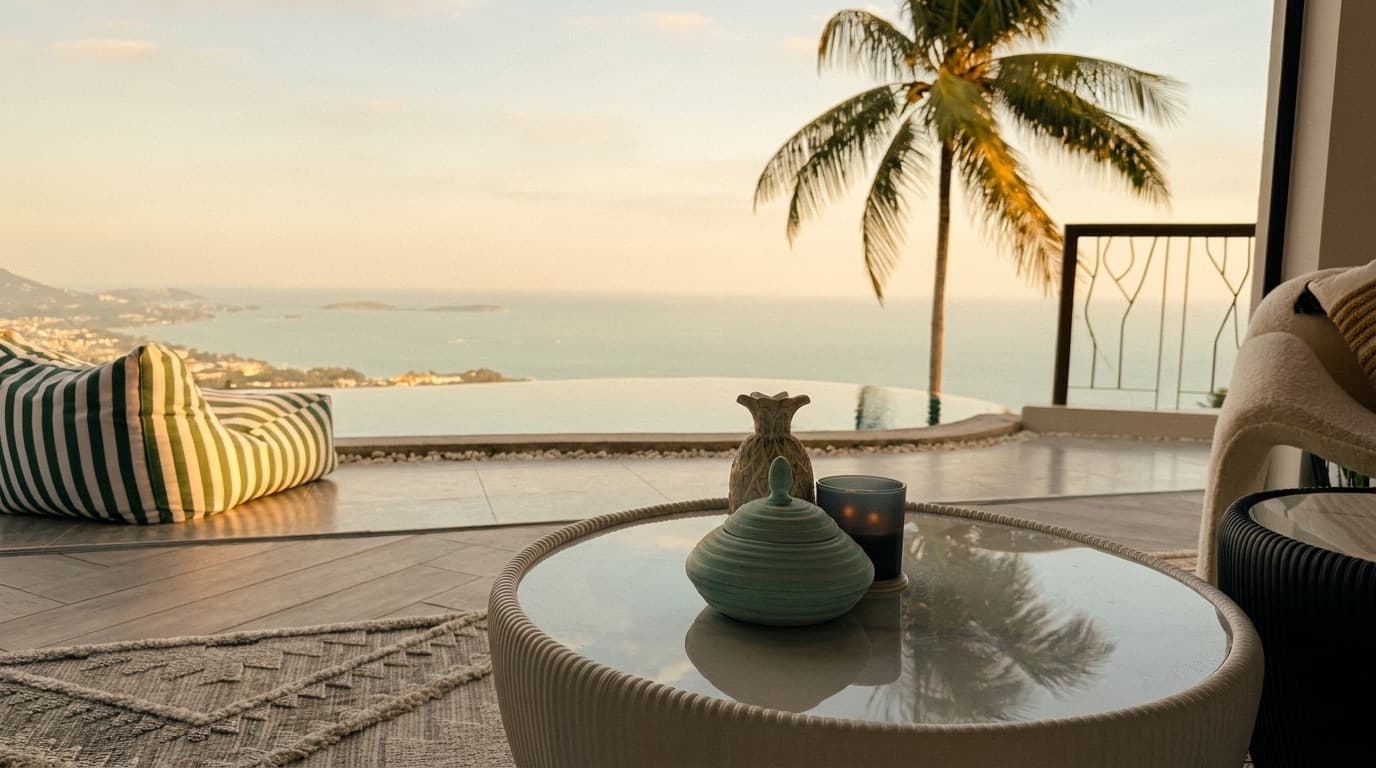
Sabai Sabai is a three-bedroom villa on the cliffs above Chaweng Noi, with an infinity pool and the whole Gulf of Thailand below.
See the villa →Written by
May
Living in the sunshine