Is Koh Samui Cash Only? The Honest Answer on Money, ATMs, and Tipping
Is Koh Samui cash only? Not quite. Here's what actually takes a card, what never does, real ATM fees, and how much to tip, from two people who live here.
May · August 12, 2026
Is Koh Samui cash only? No, not quite. It just really, really wants you to have some on you. That's a different problem, and it's the one that gets people standing outside a 7-Eleven at 9pm arguing with a card reader about whose fault this is. We live here. We pay for things here, constantly, in both baht and card. This is the actual breakdown, not the vague "bring some cash just in case" line every other guide gives you and calls a job done.
What Actually Takes a Card
The big stuff takes cards without drama. Supermarkets like Tesco Lotus, Tops, Makro, and Villa Market all run Visa and Mastercard through a normal terminal. So do proper sit-down restaurants, spa resorts, car rental desks, boutique shops, and villas, ours included. American Express works too, but only at the upper end of that list, so don't count on it at a beach shack.
Some places quietly add a 3% surcharge for card payments. It's not a scam, it's them covering the processing fee, but it's worth asking before you tap, especially on a bigger bill.
What Only Takes Cash
Everything smaller runs on baht, full stop. Songthaews, the shared pickup-truck taxis that get you around the island, want cash for the roughly 150-baht fare, and nobody's pulling out a card reader on a moving truck. Local markets, street food stalls, massage shops, Muay Thai gyms, and temple donation boxes are the same story. No one selling you a bowl of noodles for 60 baht has the margin or the machine for a card fee.
This is the part that trips people up. They budget for the villa and the nice dinners, put the card away, and then can't buy a mango on the side of the road because they've got nothing but plastic in their pocket.
The ATM Reality
You'll be using ATMs here more than you're used to, so know the numbers going in. Most machines charge a flat fee of somewhere around 220 to 250 baht per withdrawal, and that fee applies whether you take out 1,000 baht or the maximum, so taking out less often makes more sense than a string of small withdrawals. Daily limits typically sit at 20,000 to 30,000 baht per transaction, with Bangkok Bank and Krungsri machines sometimes allowing more. On top of the local fee, your own bank back home may tack on another 1 to 3% for a foreign transaction, so it's worth a two-minute check of your card's terms before you land.
The workaround is simple: pull a bigger amount less often, and you pay that flat fee once instead of five times over a week.
Changing Money, Or Mostly Just Not Bothering
Skip the airport currency counters entirely. The rates there are noticeably worse than anywhere else on the island, and you're paying for the convenience of being tired and jet-lagged. Licensed exchange booths like SuperRich and Vasu Exchange, both with branches in Chaweng and Bophut, offer far more competitive rates, and larger denomination notes get you a slightly better one than a fistful of small bills. Your hotel front desk will change money too, but expect a rate that's 3 to 5% worse than a proper booth. And bring notes that don't look like they survived a flood: torn or heavily marked bills get refused more often than you'd expect.
Realistically, an ATM withdrawal beats exchanging cash from home most of the time anyway, once you account for the exchange rate you'd have gotten at a UK or US bank before you even left.
How Much To Actually Tip
Tipping isn't compulsory in Thailand the way it is in the US, but it's expected in the same casual, appreciated way it's becoming everywhere else. Here's what actually gets used, not the generic "10 to 20%" number that belongs to a different country entirely:
- Restaurants: round up the bill, or 10% if there's no service charge already on it - Massage or spa treatment: 100 to 300 baht, scaled to the length of the treatment - Private driver: 100 to 200 baht a day - Hotel porter: 50 to 100 baht - Boat crew on a full-day charter: 500 to 1,000 baht per guest - Villa staff, at the end of your stay: roughly 5 to 10% of the total villa rate, split among the team
That last one is the number that actually matters if you're staying with us. It's not expected on top of every single day, it's one figure you settle before you leave, and it goes further than people assume toward whoever cooked, cleaned, and fixed the pool pump at 7am without you noticing.
For a fuller sense of what all this cash is actually going toward, we've broken down a realistic week's spending here. And if you're sorting your first 24 hours on the island, pair this with getting a local SIM so you can actually find the nearest ATM when you need one.
Quick Answers: Is Koh Samui Cash Only?
Is Koh Samui cash only?
No. Supermarkets, sit-down restaurants, hotels, and villas take cards. Markets, songthaews, street stalls, and small local shops don't. Carry both, every day.
What's the ATM fee in Koh Samui?
Roughly 220 to 250 baht per withdrawal, whatever amount you take out, plus anything your own bank charges on top. Withdraw a larger amount less often to avoid paying that fee repeatedly.
Do I need to tip in Koh Samui?
It's not required, but it's genuinely appreciated. A round-up or 10% at restaurants and 100 to 300 baht for a massage covers most of a normal day.
Can I pay in dollars, euros, or pounds?
No. Thai baht is what people actually take, even if a tour desk or driver quotes you a price in another currency first.
If you take one thing from this: don't rely on your card and don't carry only cash either. Land, find an ATM before you find your hotel, and you won't think about money again until it's time to tip the villa team on your way out toward Chaweng.
The Villa
Come stay above the bay.
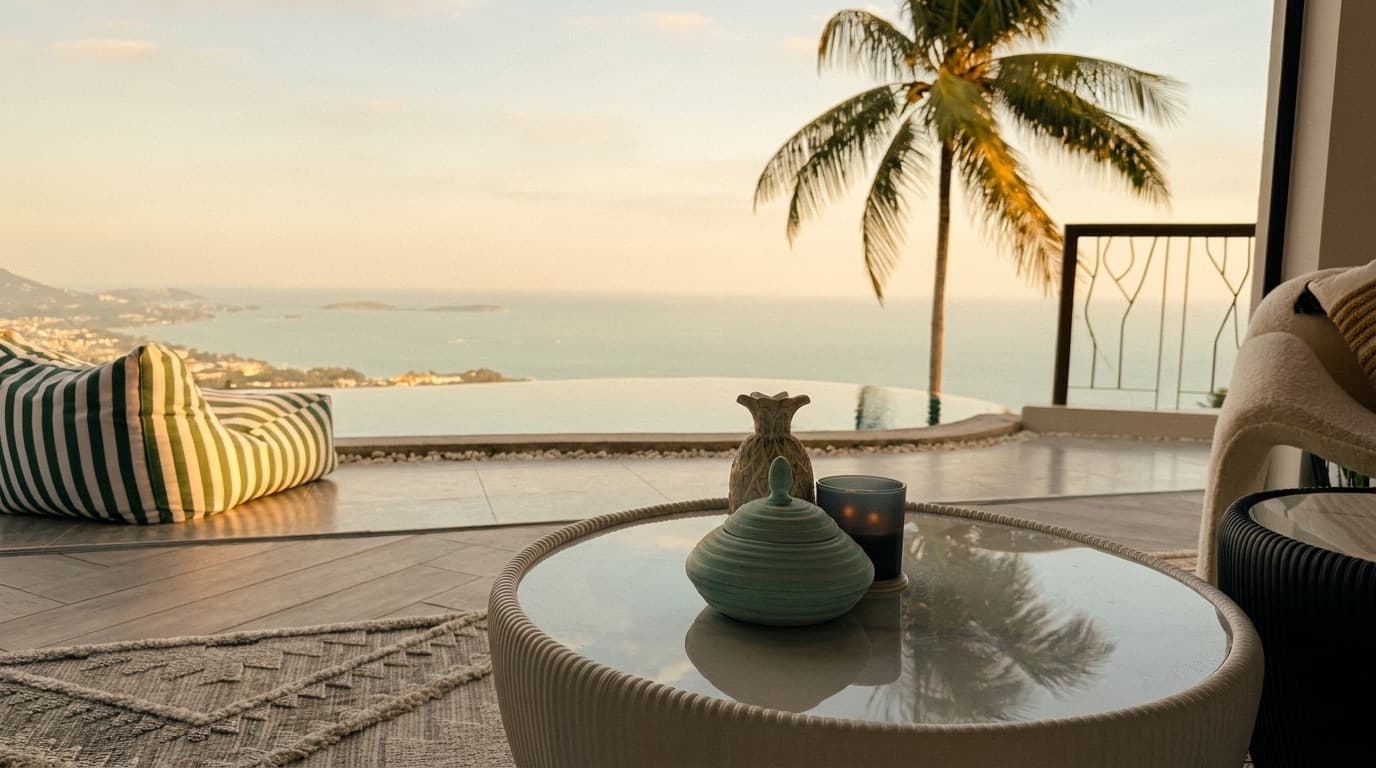
Sabai Sabai is a three-bedroom villa on the cliffs above Chaweng Noi, with an infinity pool and the whole Gulf of Thailand below.
See the villa →Written by
May
Living in the sunshine